
The third period has two minutes left, your team is up by one, and the picture locks on a spinning circle. You reload the app, the audio returns before the video, and by the time the feed catches up the goal has been scored and replayed twice. That moment isn't a pricing problem. It's a delivery problem.
Reliability is the only spec that matters once you've paid, and it's the hardest thing to judge from a sales page. Channel counts get padded, monthly figures get dressed up, and a short trial can look perfect on a quiet Tuesday afternoon. Bandwidth sits underneath all of it, and plenty of stalls trace back to the household connection rather than the provider, so start with this guide to streaming bandwidth for rural homes if you're outside a city centre.
Below are five subscription terms from Watching IPTV Canada, a service that covers customers across Canada including Toronto, Vancouver, Montréal, Calgary, Winnipeg, and Halifax. I'm judging each one against the same three checks: stream stability during peak hours, support you can reach, and trial and refund terms that give you an exit.
Table of Contents
- 1. 2 Devices – 6 Months Premium IPTV
- 2. 2 Devices – 1 Month Premium IPTV
- 3. 6 Months Premium IPTV
- 4. 3 Months Premium IPTV
- 5. 2 Devices – 12 Months Premium IPTV
- How the five Watching IPTV Canada plan options compare
- Test Before You Commit With a Simple Reliability Plan
1. 2 Devices – 6 Months Premium IPTV
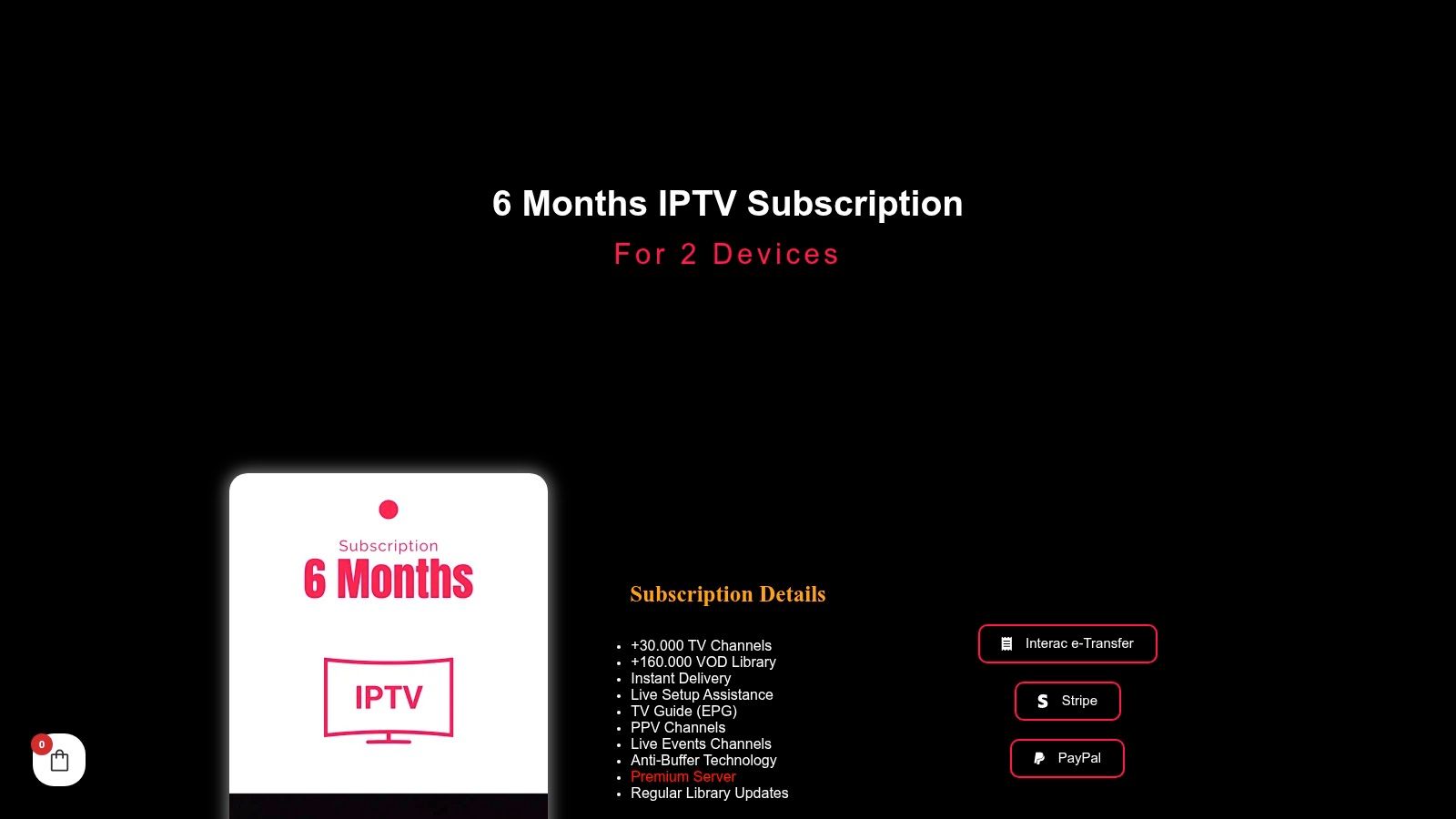
Tuesday, 8pm, two screens on at once. The living room stays on a hockey feed while a tablet in the kitchen runs a movie. If one stutters and the other stays clean, you have a capacity problem, and a six-month term has to survive that split through a full hockey season and the demand spikes that come with it.
The 2 Devices – 6 Months Premium IPTV plan fits a household that wants one decision instead of twelve monthly renewals. A provider can look fine in a quiet August and still fall apart once weeknight traffic piles up. I'd only treat this length as fair after both evening tests below hold.
What six months reveals
The first week mostly confirms that the app installs and the guide loads. Month three is where the pattern shows. You find out whether the EPG still matches the schedule, whether the channel that worked in week one still resolves, and whether the same two feeds stutter every Tuesday at 8pm.
Expectations in this market have moved. The CRTC's communications monitoring report shows IPTV penetration climbing from 20% of Canadian households in 2019 to 35% in 2023, while cable fell from 36% to 20% and direct-to-home satellite from 15% to 9% over the same period (CRTC). Your benchmark is now a managed telecom box, not a scraped stream from a decade ago.
The three checks applied to a six-month term
- Peak-hour stability: watch one live sports window on a weekday evening in week two and again in week six. If the second test is worse than the first, the term is already too long.
- Support availability: on a six-month commitment, support has to answer when the stream fails. WATCHING IPTV offers 24/7 customer support, and the support team is based in Canada, which matters when a feed drops at 9pm on a Saturday.
- Trial and refund terms: read the trial window and the refund window before you pay. A short trial only shows whether the app starts. The refund terms tell you whether you can leave if week two is unstable.
Two connections, and what that means in practice
Two simultaneous streams cover a living room television plus one phone, tablet, or bedroom set. They do not cover three people watching different things at once. If that is your house, a two-device plan will cost more in frustration than it saves.
Practical rule: before committing to any six-month term, open three channels you watch and leave one running for 90 minutes during a live game. Note the minute it first stutters.
Canadian-optimized servers are meant to limit buffering, and multiple TSN/Sportsnet backup channels give a live game a second feed if the first one fails. That redundancy is what you are paying for, and it matters more than the channel count.
2. 2 Devices – 1 Month Premium IPTV
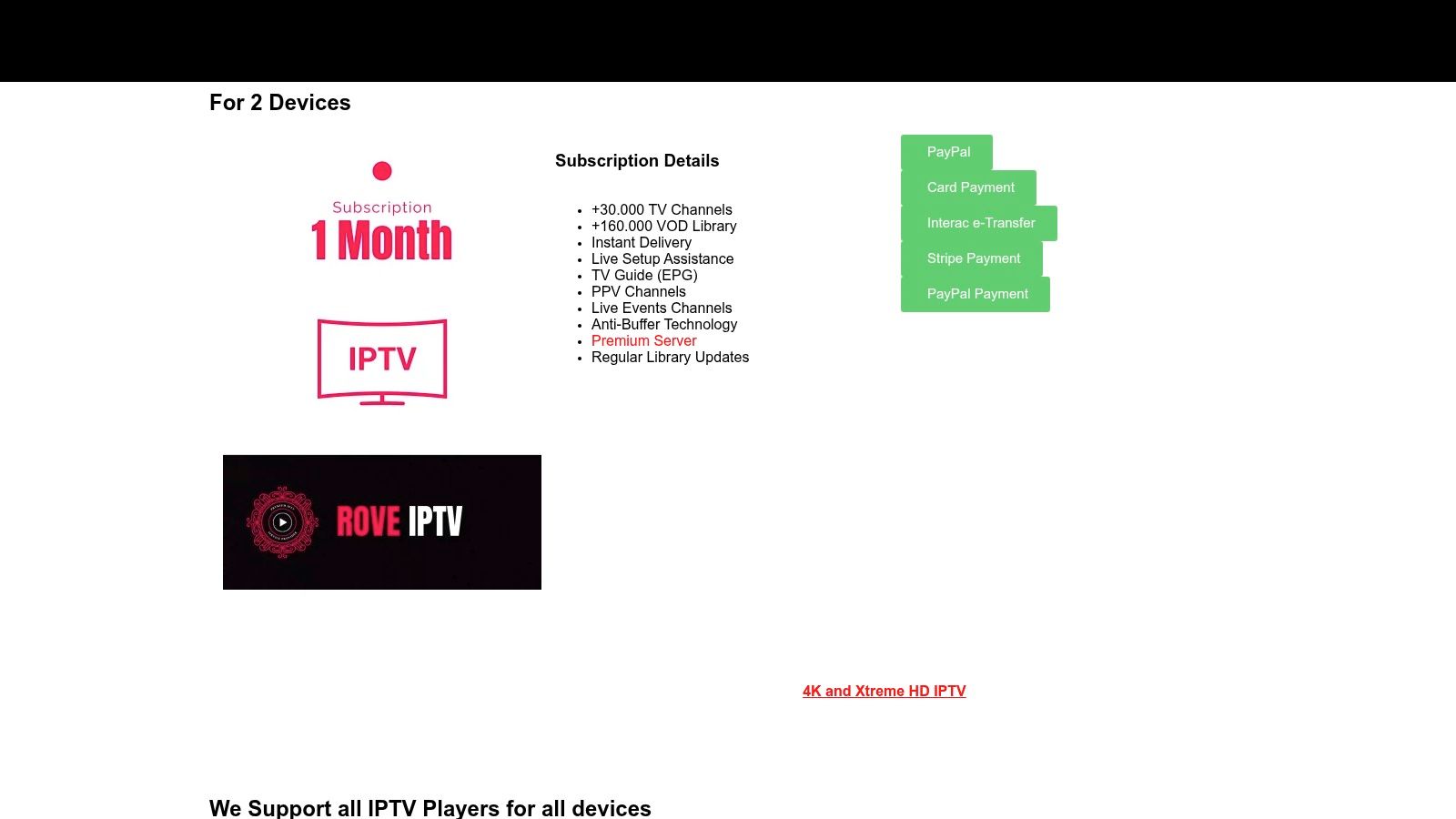
Tuesday, 7:40 p.m. The living-room TV is on the game, a second screen is on news, and the picture holds for twenty minutes before the bitrate drops. A prepaid half-year would already be spent. The 2 Devices – 1 Month Premium IPTV plan is the one I'd recommend if you have not streamed this provider before and you want a bridge off cable, not a long lock-in.
Buffering rarely has one cause. The CRTC's monitoring work identifies intermittent service and slower-than-expected speeds among the most common internet-related complaints Canadians raise (CRTC). The stall can start at the router, the Wi-Fi channel, the ISP path, the device decoder, or the provider's capacity. Thirty days is enough to separate those, and short enough that a bad verdict does not cost a season.
How to run a month as an audit
Judge the month on three things you can observe: whether streams hold during a peak-hour game, whether support answers after you have paid, and whether the trial told you anything the paid month then confirmed. Channel count and the higher monthly rate are secondary.
- Week one, baseline: install on the two devices you will use, confirm the EPG fills in, and note startup time on five channels you already watch.
- Week two, live event: stream one full game end to end on the main TV. Write down startup delay, minutes of buffering, any resolution drops, and whether audio drifts out of sync. Open one support ticket the same night and record how long a useful reply takes.
- Week three, switch test: move that TV from Wi-Fi to Ethernet and repeat the live window. If Ethernet clears the stalls, the provider was not the fault.
- Week four, decision: renew, change the device count, or stop. You are buying a verdict, so do not argue with a retention desk.
Start with the 24-hour free trial before you pay for anything. It only tells you whether the app starts. The paid weeks are what show stability.
Where the one-month term falls short
Thirty days will not show how a lineup behaves when a channel is pulled or a source changes, and it will not cover a full sports calendar. The monthly price also looks worse than a longer term. Treat the month as a test purchase, and judge it on what you observe.
A third screen sitting idle during these four weeks is untested capacity. If the household regularly watches three different things at once, this plan cannot prove that load. Two connections is the limit you are measuring.
3. 6 Months Premium IPTV
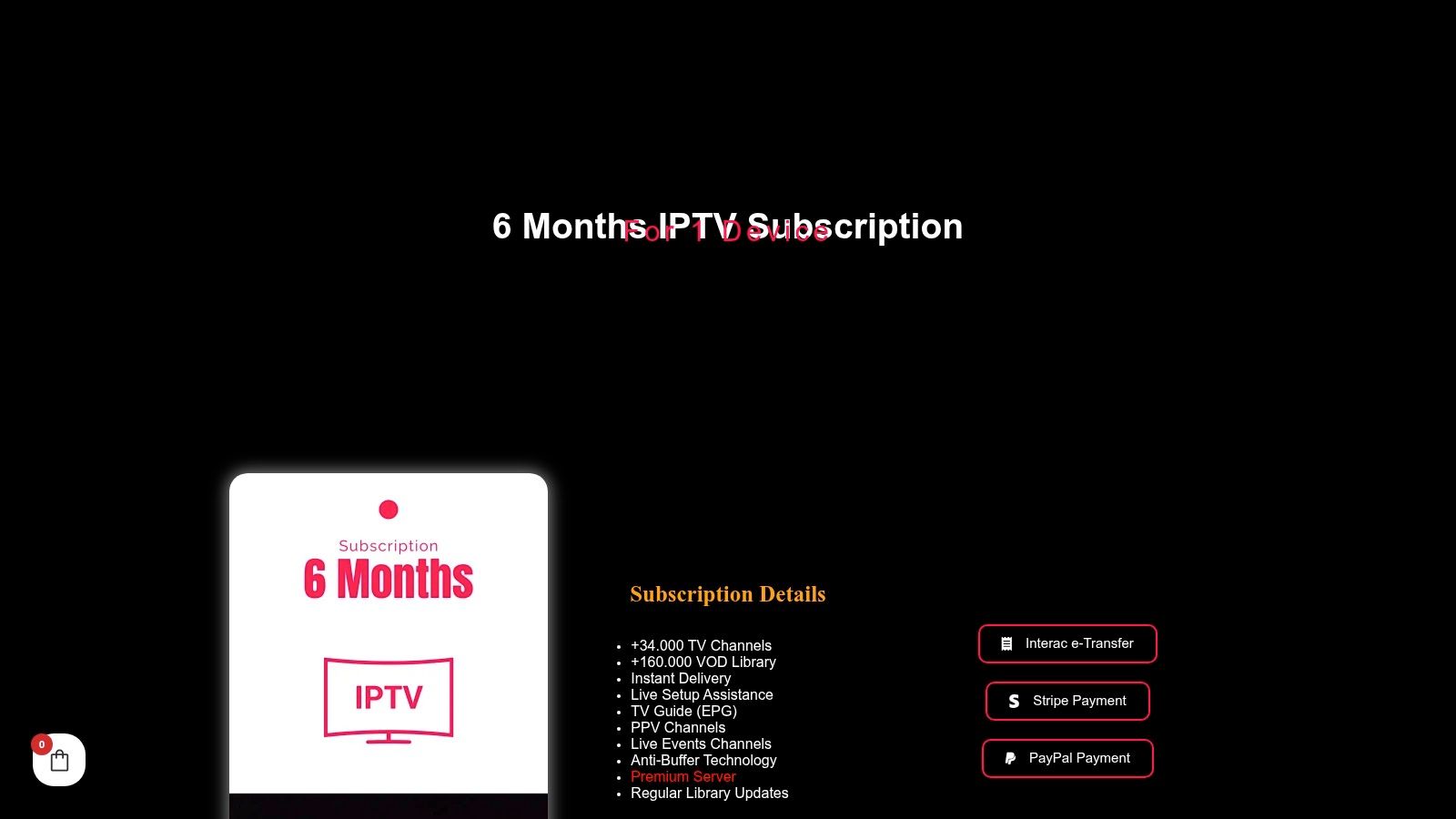
A Saturday playoff runs past 10 p.m., the rest of the house is online, and the picture either holds or it stutters. Six months of WATCHING IPTV is long enough to see whether that pattern repeats at peak hours, whether support still answers after you have paid, and whether the refund terms hold if a channel you wanted disappears. Channel totals and the monthly price do not settle those three checks.
The rights question a trial can't answer
A trial shows whether the app works. It says nothing about whether the provider is authorized. IPTV is a delivery method, not a legal category, so a service is legitimate only when the operator is allowed to distribute what it advertises. Roundups that list channel counts and device support rarely mention licensing. This IPTV Canada buying guide is a typical example.
Before paying for half a year, I'd want four items you can read without opening a chat: an identifiable business with a site and terms, a refund policy in plain language, support that still responds after payment, and a clear account of how programming is authorized in Canada, including what happens to unused time if channels go away. WATCHING IPTV offers 24/7 customer support from a Canada-based team, which covers the availability half of that check. Authorization is a separate question, and it is laid out in this guide to whether IPTV is legal in Canada. An unauthorized service can look sharp for weeks and still be a bad purchase, because access can stop without notice and you have no remedy.
Six months is also long enough for the guide to matter more than the raw channel list. A clean, accurate EPG you can search beats another block of links that never tune on a Tuesday night. WATCHING IPTV provides a channel list and a clean, accurate EPG. The plan name does not state a device limit, so confirm that number on the product page before you pay. Guessing it from the term length is how households end up short a screen.
Practical rule: ask what happens to the remaining term if a channel you subscribed for disappears. A provider with a real refund policy answers in one sentence.
4. 3 Months Premium IPTV
Three months maps neatly onto a sports season, a university term, or a winter where you're indoors more than usual. The 3 Months Premium IPTV term is the middle option, and it's the one where your own line matters most, because three months is long enough to notice every recurring problem in your connection.
Canadian broadband is not uniform, and the gap shows up in exactly the resolution you notice during a game. Statistics Canada reported that among respondents who knew their connection speed, 76% in metropolitan areas reported at least 50 Mbps, compared with 48% outside metropolitan areas (Statistics Canada). That threshold is described as suitable for multiple simultaneous users and ultra-high-definition video on more than one device.
What your own line will do to the picture
Adaptive delivery means the stream protects itself by dropping resolution when bandwidth tightens. You rarely see an error message. You just see a softer picture during the third period, which is the worst possible time for it.
- Wire the main television. Ethernet removes Wi-Fi congestion from the equation entirely, and it's the single highest-value change most households can make.
- Check who else is online. One 4K stream plus a video call plus a game download will compete for the same pipe.
- Test at 8pm, not 2pm. Congestion is a neighbourhood phenomenon, and your street's evening peak is the environment.
- Note the resolution, not just the buffering. A stream that never freezes but sits at 720p for an hour is still failing.
Three months is long enough to run that routine four or five times across different nights, and short enough that you're not locked in if your line can't carry what you bought.
Practical rule: if Ethernet fixes the problem, buy a cable before you buy a longer subscription.
Where this term earns its place is flexibility. You get a full season of viewing without committing to a year of it, and you keep the option to move to a longer term once you've watched the service behave under real load.
5. 2 Devices – 12 Months Premium IPTV
Twelve months only makes sense after a live-event test. The CRTC reports that streaming-only households rose from 23% in 2023 to 29% in 2024, while 76% of Canadians subscribed to a subscription video-on-demand service (CRTC). Homes already paying for two or three video services are deciding whether this provider keeps a permanent slot.
The 2 Devices – 12 Months Premium IPTV plan is the purchase you make once those checks are finished. Buying the year first is the expensive way to learn whether the streams hold when everyone is watching.
Measure the right thing before you commit
Headline download speed is a weak predictor of the picture on your television. Network-level video tests score startup time, how often the stream rebuffers, and the resolution that arrives. Use those three as the acceptance criteria. Play HD and 4K as separate tests, time how long the picture takes to start, and count stalls through a full live event.
I would not sign a year from a speed-test screenshot. What matters is whether both screens stay stable for the whole broadcast.
Running two screens for a full year
Two connections across twelve months fits a couple, or a home where the second screen is a tablet in the kitchen. That ceiling is the deal you live with on nights when a third person wants their own stream.
Most multi-device failures are local. This guide to running IPTV on multiple devices in Canada covers splitting one subscription across a TV, a Fire Stick, and a phone.
Buy one month, run both devices through a live event, and move to twelve months only if startup, rebuffering, and picture quality held. Fixed-term access with no auto-renewal means the next decision is yours at the end of the year. Judge that upgrade on peak-hour stability, on whether support answers when a stream fails, and on what the one-month term already showed you.
How the five Watching IPTV Canada plan options compare
These five plans are one service with two variables: term length, and whether a second connection is included. The channel list, adaptive 4K/HD/SD, EPG, sports backups, and 24/7 support do not change by row. What changes is how many peak evenings you can watch, and whether a second screen is in that sample.
The 24-hour trial and the seven-day refund on new subscriptions apply to every row. A longer term does not extend either window. I treat that refund as a short proof period, not as cover for a whole season. Fixed-term billing with no auto-renewal means the renewal decision is yours at the end of whatever you bought.
| Item | Term | Connections | Reliability check |
|---|---|---|---|
| 2 Devices – 6 Months Premium IPTV | 6 months | 2 | Two screens across a run of live nights. The second stream is usually the one that drops first on a busy home network. |
| 2 Devices – 1 Month Premium IPTV | 1 month | 2 | Same two-screen load for one billing cycle. Enough live events to see whether buffering repeats before you choose a longer term. |
| 6 Months Premium IPTV | 6 months | 1 | Single-viewer variant. No second screen to blame, so stalls point at the stream or the ISP. |
| 3 Months Premium IPTV | 3 months | 1 | Single viewer over a shorter fixed term. A partial season on one screen, with the same seven-day refund as the longer plans. |
| 2 Devices – 12 Months Premium IPTV | 12 months | 2 | Two screens for a full year. The refund still ends in a week, so the extra months are not extra test time. |
Test Before You Commit With a Simple Reliability Plan
A household's viewing setup can guide the plan choice. Statistics Canada found that 69% of Canadian internet users paid for or used an online video-streaming subscription, and 41% had a smart television at home (Statistics Canada's household survey). Those figures point to two practical questions: how many people will watch at once, and which devices will they use?
| Household setup | A practical starting point |
|---|---|
| One viewer, one screen | Compare the six- and twelve-month options if the service suits your routine. |
| Two viewers, two screens | Choose a two-device plan; use the term that matches how long you want access. |
| Several viewers sharing screens | Check the plan's device limit before choosing a term. The one-month option can limit the initial commitment while you assess household fit. |
Treat the table as a starting point, not a guarantee of performance. A longer term makes sense only when the plan's device allowance and your expected viewing period both fit.
Before paying, check the trial and refund terms together: WATCHING IPTV offers a 24-hour free trial and a seven-day money-back policy for new subscriptions. Once you know how many screens the household needs, use the trial to decide whether to proceed with a fixed term. Visit Watching IPTV Canada to view the current plans and start a trial.
No Responses